Used EVs: What to Inspect Before You Buy
A second-hand electric car is mostly a paperwork purchase with a test drive attached. The two facts that decide the value are a published key parts warranty of 8 years or 160,000 km covering the traction battery and drive motor, with a minimum of 70 per cent of original capacity during that period, and a service schedule of every 12 months or 20,000 km. Both can be checked before you hand over money.

Key takeaways
- Key parts cover runs 8 years or 160,000 km, with a 70 per cent minimum capacity floor during that period.
- The vehicle warranty covers cars imported into Australia by XPENG's Australian business and registered in Australia.
- Scheduled maintenance is every 12 months or 20,000 km, whichever comes first, through an XPENG Authorised Dealer.
- Roadside assistance runs for 7 years from first registration, and remote diagnostics is standard.
Paperwork before panel gaps
Start with the question of who imported the car. The published warranty terms apply to vehicles imported into Australia by XPENG's Australian business and registered in Australia, so an import that arrived by another route may sit outside the cover that makes a used purchase comfortable.
Then confirm what remains of the term rather than what it said when new. Registration date, odometer and the warranty manual together tell you whether the car still has years of key parts cover or months of it, and how much of the 160,000 km allowance has been used.
Support is provided directly by XPENG ANZ, and customers who bought through TrueEV are directed to XPENG ANZ support. A quick call before purchase confirms which path applies to the car you are looking at.
The 70 per cent capacity floor, in practice
The capacity floor is the single most useful sentence in a used electric car's paperwork. The published term says the traction battery provides a minimum of 70 per cent of its original capacity during the key parts period, and it also states that gradual capacity reduction is normal for traction batteries.
Those two statements belong together. Degradation is expected; the warranty defines where it becomes someone else's responsibility. On a car still inside the key parts period, that is protection you inherit.
Ask for any battery health documentation the seller holds, then have an XPENG Authorised Dealer check the car. A capacity claim depends on a measurement and a record, so the inspection is worth arranging before you negotiate rather than after.
The checklist that matters on a used EV
| Check | Why it matters | Where the record should be |
|---|---|---|
| Service history | Shows the 12-month or 20,000 km schedule was followed | Dealer records and the owner's handbook |
| Battery capacity | The 70 per cent floor applies during the key parts period | Warranty manual and dealer measurement |
| Key parts cover remaining | 8 years or 160,000 km from first registration | Registration date plus odometer |
| Software and OTA history | The cockpit interface is OTA-upgradable over Wi-Fi or mobile network | In-car screen and Owner's App |
| Roadside assistance | Runs 7 years from first registration | XPENG ANZ support, 1800 255 494 |
Service history against the 12-month schedule
An electric car has fewer moving parts than a petrol car, which is exactly why a gap in the record is more revealing rather than less. The published schedule is every 12 months or 20,000 km, whichever comes first, and servicing is recommended through an XPENG Authorised Dealer.
A five-year-old car with a documented annual visit and an odometer under 100,000 km has had the visits the schedule asked for. A car with the same distance and only two stamps has not, and the reason is worth asking about before you make an offer.
Also ask where the record lives. The XPENG Owner's App schedules maintenance and services, and remote diagnostics is standard equipment that can sometimes resolve an issue without a workshop visit. An owner who used those tools leaves a tidier history.
Software history and the OTA question
The New G6 runs an Xmart OS cockpit with an OTA-upgradable interface and customisable in-car scene modes, with updates delivered over Wi-Fi or a mobile network. On a used car that is good news, because a well-maintained car can have gained features rather than lost them.
Check the software state in person. Open the settings screen, look for the update history and confirm the car is on a recent version. If it has not been updated for two years, that suggests the previous owner was not engaged with the car, and it may also mean the vehicle was not connected to a network.
Then check the physical equipment that the software supports: XPILOT ASSIST is an assistance function rather than a substitute for the driver, and the published footnote makes clear that the driver must stay aware, monitor traffic and take over when needed. Ask the dealer to demonstrate the current state of the system so you know exactly what you are buying.
Worked example: a year of running a used EV
This is illustrative arithmetic with the assumptions stated, written to show how the numbers go together rather than to predict your bill. No price or consumption figure for any XPENG model is published on the Australian site.
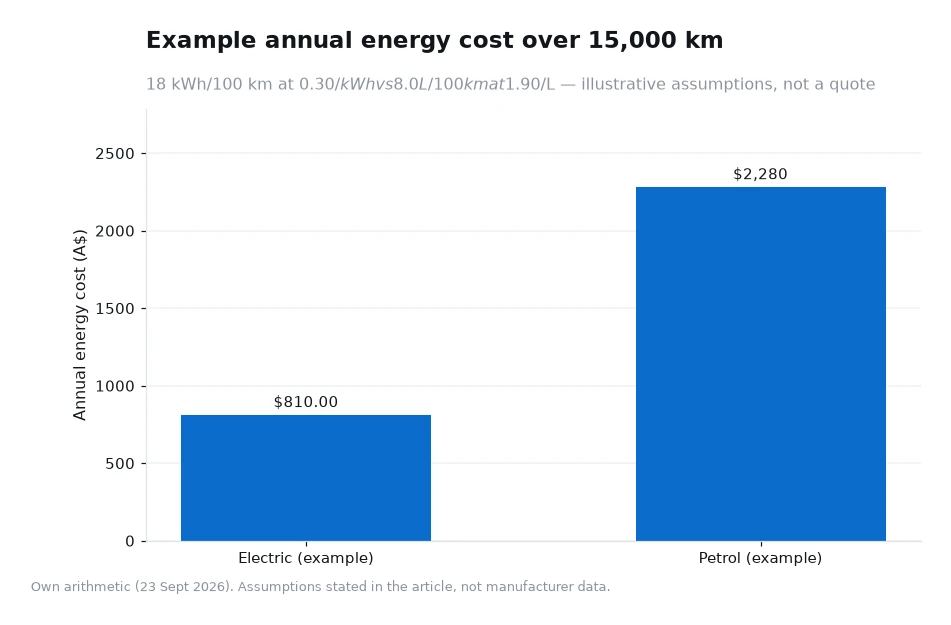
Assume 15,000 km a year, an electric car using 18 kWh per 100 km, electricity at 30 cents per kWh, a petrol equivalent using 8.0 L per 100 km and petrol at 1.90 dollars a litre.
Electric: 15,000 divided by 100 is 150 units of 100 km, and 150 x 18 = 2,700 kWh. At 30 cents, 2,700 x 0.30 = 810 dollars for the year, or about 810 divided by 52 = 15.60 dollars a week.
Petrol: 150 x 8.0 = 1,200 litres, and 1,200 x 1.90 = 2,280 dollars for the year, or about 2,280 divided by 52 = 43.85 dollars a week. The gap in this example is 2,280 minus 810 = 1,470 dollars over twelve months.
Servicing is separate and no service pricing is published for Australia. On the published interval, 15,000 km a year means the 12-month rule fires each year, so one visit a year and five visits across a five-year ownership. Ask a dealer for a written quote before you buy, and include it in your offer.
Frequently asked questions
How do I check the battery on a used electric car?
The published key parts warranty provides a minimum of 70 per cent of original capacity during the 8 year or 160,000 km period, and gradual capacity loss is described as normal. Ask for existing battery documentation and have an XPENG Authorised Dealer measure the car before you buy.
Is a used EV still covered by the manufacturer warranty?
Published cover applies to vehicles imported into Australia by XPENG's Australian business and registered in Australia, and the terms run from first registration for the periods stated. Check the registration date, odometer and service record to work out what remains on the car you are considering.
Inspection day: what to bring
Take a phone, the registration papers, your own charging cable if you have one, and a list of the questions above. Test the charge flap on the right rear quarter panel, press the top-left corner and open it, because it is the part you will touch more often than any other. Sit in every seat, fold anything that folds, and check that the boot takes the pram or the bike rack you actually own.
Then drive it far enough to see the range indicator move. A ten minute loop is not enough, so ask for a route that includes a hill and a stretch of highway.
Published specifications and warranty terms for the electric suv australia range are on the manufacturer's Australian pages, so you can compare the car in front of you against the factory detail. Use Find a Dealer to book a pre-purchase inspection, and read the warranty overview before you negotiate.
Warranty, service and specification details in this article come from the manufacturer's Australian site at xpeng.com/au, read on 23 Sept 2026, with conditions and exclusions in the XPENG ANZ Warranty and Maintenance Manual for Australia. The distance, consumption and price inputs used in the example are the author's own assumptions. [1]