Reading Marketing Copy About 'Realism'
"Realistic" is the most repeated and least defined word in adult AI marketing, so it pays to know what the platform actually claims. This one claims realistic advanced responses: text that is natural, adaptive, recalls previous interactions and changes over time. Nothing in that sentence involves a real person, and the 2257 statement says so directly. A twenty-message test - ten minutes of your time - will tell you more than any adjective will.

Key takeaways
- Translate the word before judging it: realistic here means natural, adaptive responses that recall earlier messages, not imagery.
- Three tests measure it - continuity of a stated detail, emotional range, and whether the character can be disagreed with.
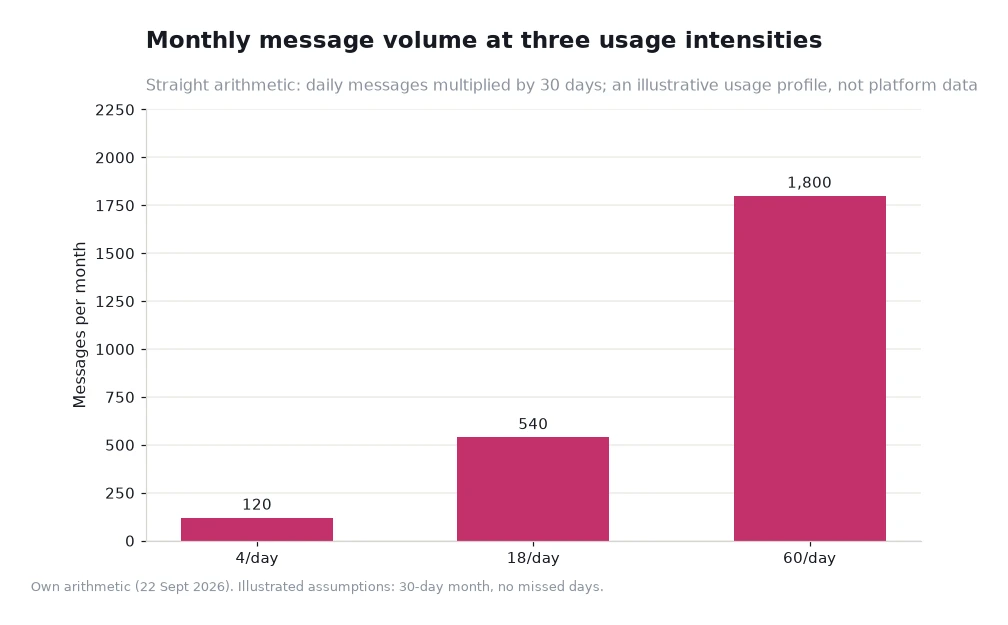
- A twenty-message test is 10 minutes; at 540 messages a month that is 3.7% of your volume, and at the lightest pace 17% of a 120-message month.
- Treat absolute wording as a red flag in copy, whether it promises perfection or promises privacy.
What the claim says, word by word
The platform's realism claim is built from four parts: responses that are natural, responses that adapt, characters that recall previous interactions, and characters that express emotions and change over time. Each part is about behaviour, which makes the whole claim testable. Even better, all four describe properties you can observe in an afternoon rather than properties that require a month of experience.
What the claim does not say is equally important. It does not claim a real person, a photograph or a video, and the platform's 2257 statement rules those out in its own words: the content is AI-generated text, no real person is depicted, and the site does not produce images or video. Any marketing line that invites you to imagine otherwise is being read too generously - by you, not by the seller.
There is also a useful asymmetry in adult marketing copy worth remembering. Volume claims, quality claims and realism claims are all cheap to make and hard to verify, while a published statement with a date on it is neither. When two sources disagree, weight the one that will still be defensible next year.
Three tests that measure realism properly
The first test is continuity. State one specific detail early - a place, a habit, a preference - and refer to it twenty messages later without repeating it. A response that picks the detail up correctly is evidence for the memory claim; a response that re-invents it is evidence against. This is the single most informative test available, and it costs nothing but attention.
The second is emotional range. Send three messages with clearly different tones and see whether the replies follow. A character that responds to a change of register has range; one that maintains the same warmth regardless is running a pattern. Range is the part of realism that most readers actually notice, and it is the part most quickly lost when a conversation runs long.
The third is disagreement. Put a mild contradiction or a plain "no" into the conversation and see whether it is accepted or steamrolled. Adaptiveness shows up here, because a character that can change direction is responding to you rather than to its own previous message, and the platforms's own wording about adapting over time predicts exactly this behaviour.
| Part of the claim | How to test it | A failing result looks like |
|---|---|---|
| Natural responses | Read twenty replies for repetition of phrasing | The same sentence shapes returning every few messages |
| Adaptive responses | Change register twice and watch the replies follow | Identical tone whatever you send |
| Recalling earlier interactions | State one detail, refer back to it later | The detail comes back invented rather than remembered |
| Expressing emotion, changing over time | Introduce mild disagreement | Disagreement is ignored and the pattern continues |
| No real person depicted | Read the 2257 statement rather than the marketing page | Marketing copy that implies otherwise |
Worked example: pricing a realism test
Run the arithmetic before you decide the test is too much trouble. Twenty messages at 30 seconds each is 10 minutes of writing, plus reading time on the replies. Three tests - continuity, range, disagreement - fit inside the same twenty messages if you plan them, so the cost stays at about 10 minutes and one shortlist slot.
Against the chart below, which multiplies daily messages by 30 days, that test is 3.7% of a 540-message month, 17% of a light 120-message month and 1.1% of a 1,800-message month. The conclusion is straightforward: if you send at a middle or heavy pace, testing a card properly before you commit to it is almost free. If you send at the lightest pace, test only when two cards are genuinely close.
Then translate the result into a decision rather than a verdict. One failing test on a card is a reason to try a different card, not a reason to doubt the category, and two cards that both fail the continuity test is a reason to change the tag you are browsing. All percentages here are illustrative arithmetic, not platform data.
Reading the rest of the page in the same way
Once you have a test for realism, apply the same scepticism to everything else on a product page. Customisation claims should name what is customisable - this platform names unique personalities, appearances and interaction styles, which is specific enough to check. Privacy claims should use the client's own phrasing rather than an upgraded version of it, which is why "private and secure environment" and "state-of-the-art encryption" should be read at face value and never as a promise that nothing can go wrong.
Restriction claims deserve the most care, because the interesting answer is always the specific one. On this platform the FAQ says some limitations apply in accordance with its content and community guidelines, which is a plain admission that an unfiltered product still has boundaries. Copy that omits that sentence is not lying, but it is describing less than the product does.
Use the sources rather than summaries. The Crushon page for porn ai is where the realism wording and the restriction answer quoted here both appear, and its FAQ uses the platform's own term, Porn Chat AI, when it answers how realistic the interactions are. For the factual boundary, the 2257 compliance statement is the document to hold beside any marketing sentence, since it describes the content itself rather than the experience of it.
Frequently asked questions
What does "realistic" mean on an adult AI platform?
It refers to the writing: natural, adaptive responses that recall earlier messages and change over time. It does not refer to real people, photographs or video.
How many messages does a realism test need?
About twenty, or 10 minutes at 30 seconds a message. Plan all three checks - continuity, range, disagreement - inside that single session.
Should I distrust every marketing claim?
Not distrust, translate. Check whether each claim names something observable; if it does, test it, and if it does not, read the platform's own statement instead.
Test one claim, then decide
Pick the claim that matters most to you - for most readers it is continuity - and test it in a single twenty-message session with a specific detail stated early and referred to later. Write the result in one line. That line, plus the 2257 statement and the FAQ restriction answer, gives you a description of the product built from evidence rather than from adjectives, and it takes less time than reading the marketing copy twice.
Data: platform wording on realistic responses, adaptation and restrictions, plus the 2257 statement, read 22 Sept 2026[1]. Message counts and percentages are own arithmetic presented as an illustrative profile, not platform data. Content described is AI-generated text. Intended for adults aged 18 and over.