Packaging Lines for Small Breweries: Costs and Constraints
The filling line is usually the last purchase decision and the first bottleneck. Vessels can be added over a weekend; a canning or bottling line has to fit through a door, be fed by people and be served by power, water and drainage. This article walks through the three constraints that decide whether a small line runs smoothly, and works through the arithmetic for a 1,000 litre brewhouse.
Key takeaways
- Space is set by conveyor length and buffer, not by the filler head; plan the room around the line, not the reverse.
- Labour follows the pack format: a kegerator needs one person, a small canning line usually needs two or three.
- Utilities and drainage have to be sized for cleaning as well as filling, because caustic and rinse water dominate the load.
- A 1,000 litre batch is about 2,000 bottles of 500 millilitres, or roughly 3,030 cans of 330 millilitres.
What a small packaging line actually contains
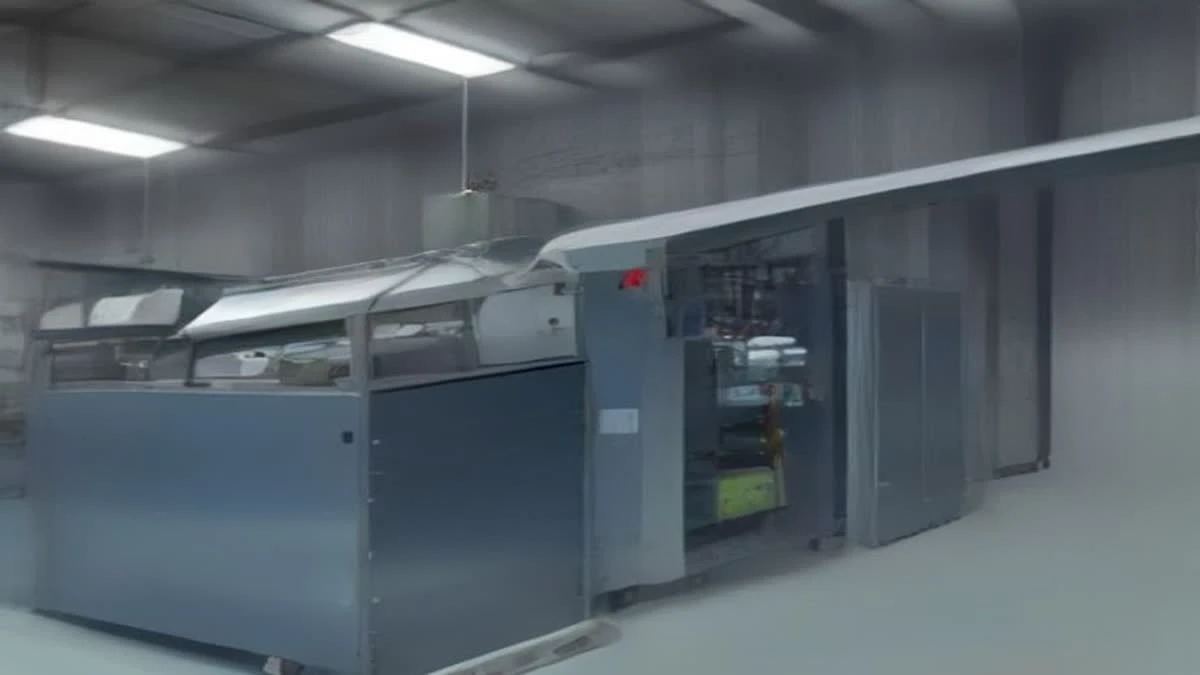
Start with the list, because each item costs money and floor space. A basic small line includes an infeed table or rinser, the filler itself, a seamer for cans or a capper or corker for bottles, a date coder, an accumulation conveyor and an outfeed table where filled packages are packed and palletised. Add a label applicator if the packages are not pre-printed, and a keg line if draught is part of the plan.
Cleaning is part of the line, not a separate chore. A small filler has to be rinsed and sanitised between runs, and that means a clean-in-place connection or at least a hose point, a drain and somewhere to mix solutions. Budget the cleaning time in the shift, because a two-hour fill behind a one-hour clean is a four-hour working block. In a brewing plant of this size, the packaging area is also where most of the water meter's movement comes from.
Most breweries start with a single-format line and accept that it is slow. The published range on the filling side of the equipment market runs from counter-pressure fillers for craft volumes up to fully automatic canning, bottling and kegging machines, and the same catalogue that lists the vessels also lists the machines that fill them; the manufacturer's Brewing Equipment pages put brewhouse, filling and auxiliary items side by side.
Space: the constraint people underestimate
A filler head occupies a square metre. The line around it occupies six. Infeed, outfeed, pallet staging, and the space in front of a control panel where an operator has to stand all count as usable footprint, and so does the walkway that lets a pallet truck reach the palletiser.
Height matters as well as floor area. A canning line with a depalletiser needs clearance above the infeed, and the ceiling must still allow a light fitting and a sprinkler head. A room that measures well on paper can fail on the day because the conveyor cannot be loaded from the chosen side.
Expansion room is the least costly thing to buy and the most expensive thing to retrofit. Leave two metres of free floor beyond the outfeed and the line can grow to a second packing station or a shrink-wrapper without moving the tanks that were installed next door.
Labour and utilities: the running constraints
People are the constraint that shows up in the wage bill rather than the quotation. A three-head bottle filler running 1,500 bottles an hour needs one person feeding, one packing and one on the filler itself for quality checks. A counter-pressure line built around a slower throughput can be run by two people. A six-head canning line at 2,000 cans an hour is a two or three person job if the outfeed is manual.
Utilities follow the pack format. Canning and bottling lines consume water for rinsing and compressed air for actuators, and they produce a lot of wastewater during cleaning. Drainage has to handle a fast dump of cleaning solution, and the floor needs a fall towards it. Where steam is used for the brewhouse, the same boiler room usually serves the filling area, and the electrical supply has to carry the filler's motors and any coder or labeller without sharing a circuit with the tanks.
| Pack format | Typical small-line speed | Space and labour | Main utility load |
|---|---|---|---|
| Keg | Up to 40 kegs an hour | One person, small footprint | Cleaning water and air |
| Bottle, 500 mL | 1,000 to 2,000 bottles an hour | Two to three people, long conveyor run | Rinse water, air, drainage |
| Can, 330 mL | 1,000 to 2,000 cans an hour | Two to three people, low ceiling clearance | Air, water, wastewater |
| Mixed keg and bottle | Depends on the slower run | Shared staging space, more changeovers | Must cover both clean regimes |
How batch size decides line size
The line does not need to be faster than the brewery's realistic packaging rhythm, and packaging rarely happens every day in a small plant. It is more common to package twice a week and to size the line for one batch per session, with a margin for the day a fermentation finishes late.
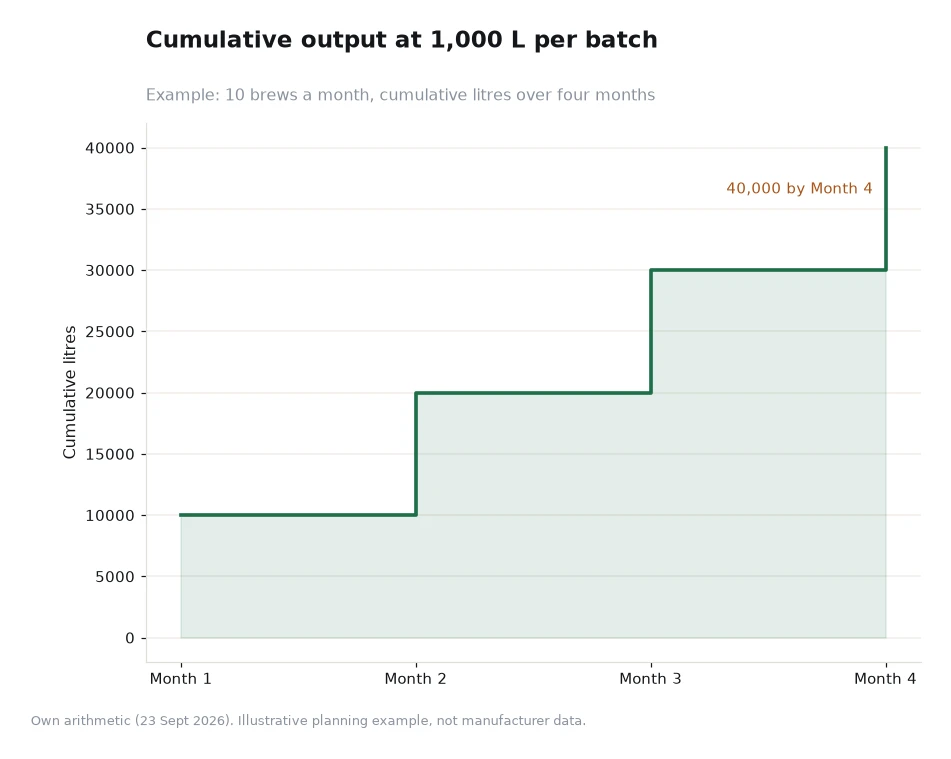
The cumulative output picture makes the volumes concrete. At 1,000 litres per batch and 10 brews a month, a brewery produces 10,000 litres in month one, 20,000 litres by the end of month two, 30,000 by month three and 40,000 litres by month four. That is the tonnage the filling area has to absorb, whether it arrives as kegs, bottles or cans.
Worked example: sizing a line around a 1,000 litre batch
Assumptions first: batches of 1,000 litres, 10 brews a month, 500 millilitre bottles or 330 millilitre cans, and a filler running at 1,500 bottles or 2,000 cans an hour. Conversion is straightforward because 1 litre is 1,000 millilitres.
Bottles: 1,000 litres multiplied by 1,000 gives 1,000,000 millilitres, divided by 500 is 2,000 bottles per batch. At 1,500 bottles an hour, filling takes 1.33 hours, and a 30-minute clean and setup makes a working block of about 1.83 hours. Ten batches a month is 13.3 hours of filling and 5 hours of cleaning, or 18.3 hours of packaging work in total.
Cans: the same 1,000,000 millilitres divided by 330 is 3,030 cans per batch. At 2,000 cans an hour, filling takes 1.52 hours and the block with cleaning is about 2.02 hours, which is 20.2 hours a month. Cans are therefore marginally slower per batch on this line speed but lighter to palletise and cheaper to store empty, which is usually why a first line goes to cans.
Now convert the result into space. Two packaging sessions a week needs staging for four pallets of empty and four of full goods at any moment. A pallet of 500 millilitre bottles holds roughly 1,000 bottles, so a single 2,000 bottle batch is two pallets of finished stock before any bulk storage. That is the figure that decides the size of the filling room, not the filler's own dimensions.
Frequently asked questions
Should a small brewery buy a canning line or a bottling line first?
Cans are lighter, stack more densely and are easier to run on a compact line, while bottles suit certain styles and premium price points. Many small breweries start with cans for volume and draught kegs for local trade, then add a bottle line when the recipe portfolio justifies the changeover time.
Can a filling line share the brewhouse cellar space?
It can share a room, but not the utilities: the filling area needs its own drainage capacity and enough free floor for staging. Keeping the line outside the tank area also keeps cleaning chemicals away from fermentation vessels and avoids moving pallets through a narrow gap between tanks.
Buy the room before the machine
Measure the room, mark the conveyor route on the floor with tape, and walk it with the people who will stand there for four hours. Sketch the pallet staging, the drain, the hose point and the panel access, then take those drawings to a supplier as a requirement rather than a description. Hermann lists filling machines alongside tanks, so the same quotation can cover the vessels, the filler and the auxiliary equipment, and the brewhouse pages show which vessel sizes feed which batch volumes.
Then check the after-sales side of the line before you commit. Ask for the spare-parts list for the filler, the training days included, and the warranty position on the electronic components, which the manufacturer publishes as 6 years on tank accessories and electronic components against manufacturing defects from the factory when used within scope. Delivery is published at 90-150 days from deposit to door, so the room, the drainage and the power can be finished while the line is being built. The contact page is the place to start that conversation with drawings in hand.
Figures in this article come from the manufacturer's own website, read 23 Sept 2026, including the published filling machine range, the 6-year warranty wording and the 90-150 day delivery window; bottle, can and pallet counts are this article's own arithmetic with every assumption stated. Details: [1]