Premium is the most overused word in fragrance marketing and one of the most precise words in production planning. It does not describe a concentration, a bottle weight or a price point. It describes a set of tolerances a factory is willing to hold — on resting time, fill accuracy, filtration, batch matching and documentation — even when holding them costs days and yield. A brand can buy an expensive product without buying any of that.
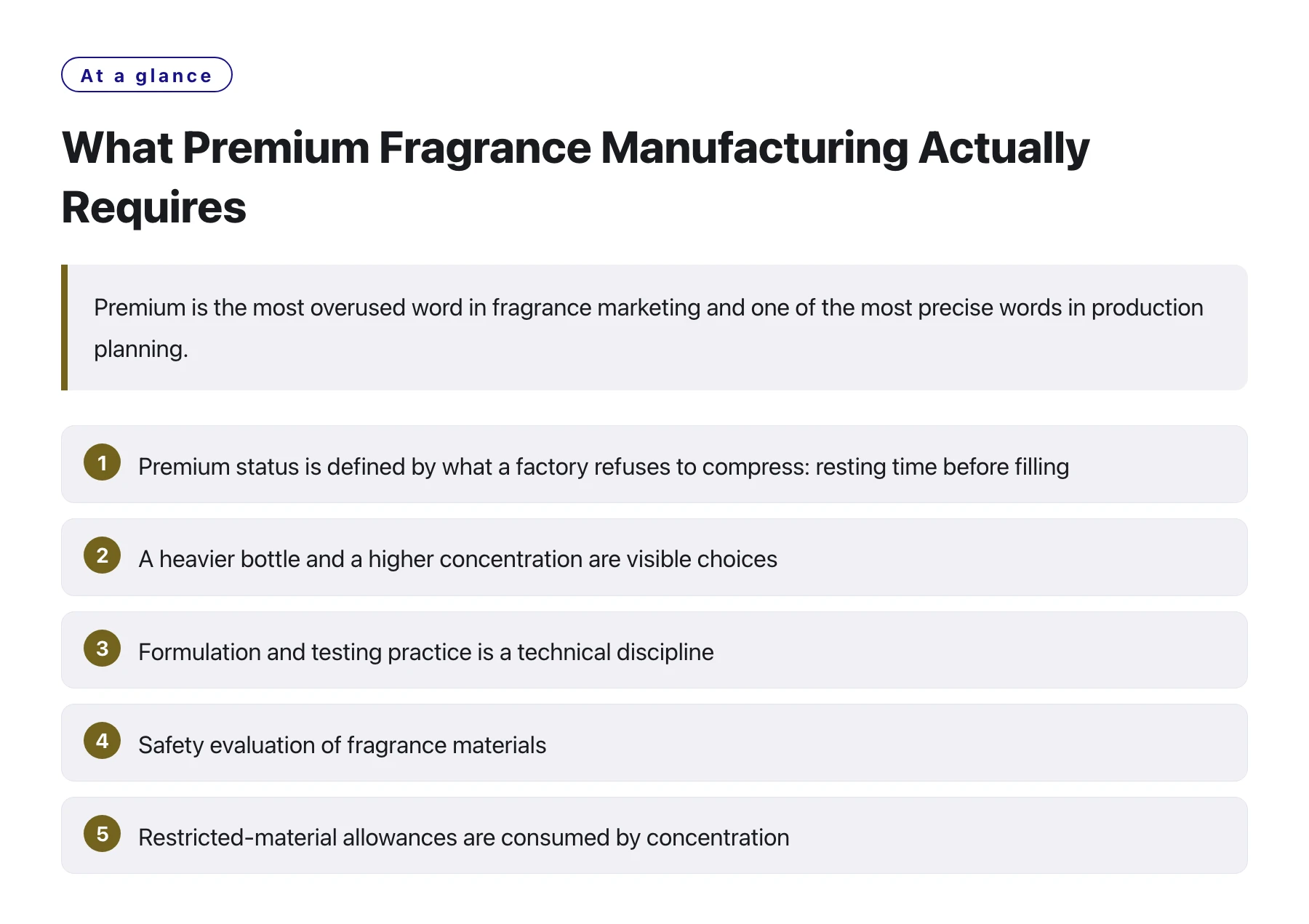
Key takeaways
- Premium status is defined by what a factory refuses to compress: resting time before filling, filtration, batch matching and release testing.
- A heavier bottle and a higher concentration are visible choices; consistency between production batches is the invisible one that customers notice over repeat purchases.
- Formulation and testing practice is a technical discipline, and the details of how a formula is evaluated are documented in the formulation trade literature [1].
- Safety evaluation of fragrance materials, including sensitisation questions, is handled at the scientific level and feeds into the limits a manufacturer must respect [2].
- Restricted-material allowances are consumed by concentration, so a premium formula is also a formula with less regulatory headroom to give away [4].
Buyers often assume that a premium product is simply a more expensive version of a standard one: more oil, a thicker bottle, a heavier cap, a box with a magnetic closure. Those choices are real, and they are the easy ones. They can be specified in a single meeting.
The harder part is invisible in a photograph and obvious in use. It is the question of whether the second production batch smells like the first, whether the fill level in month six matches the fill level at launch, and whether the factory will hold a batch back for another week because it is not ready.
This article sets out what premium manufacturing requires in operational terms and how to write a specification that a factory can actually hold to.
What the word has to mean on the production floor
In production, quality is expressed as a tolerance. A fill level within a range, a colour within a limit, a batch within an olfactive distance from a retained reference. Premium means the range is narrow and the factory checks it rather than assuming it.
That definition has a cost, and the cost is mostly time rather than materials.
Perceived quality is a tolerance, not an adjective
A customer cannot measure the oil load in a bottle, but they can notice a fill level that drops between purchases, a spray that weakens halfway through, or a scent that smells slightly different in the second bottle. Those are tolerance failures, and they accumulate into a judgement about the brand.
Setting the tolerances is therefore a brand decision. A factory can only hold a standard it has been given, which is why vague references to premium quality in a brief rarely change what happens on the line.
The steps that cost money to hold
Three process steps separate a controlled production run from a rushed one: the resting period after blending, filtration before filling, and the comparison of the bulk batch against a retained reference before release. Each takes time and each can be shortened under commercial pressure.
Formulation and testing practice in the cosmetics trade covers how a formula is evaluated for stability, compatibility and performance, and those methods are what make a written tolerance meaningful rather than decorative [1].
If you want one question that reveals how a factory treats premium work, ask what happens when a batch is not ready on the day it was scheduled to be filled. The answer tells you more than any certificate. A producer that fills it anyway has decided that the schedule outranks the product; a producer that holds it and communicates the new date has decided the opposite, at its own cost. This is a genuinely awkward question to ask, which is exactly why it is informative. Ask it before the first order, not during it.
Where premium shows up in the production record
| Production stage | Standard practice | What a premium specification adds |
|---|---|---|
| Bulk blending | Blend to formula, record weights | Recorded order of addition, mixing parameters and a retained bulk sample per batch |
| Resting period | A short rest before filling | A fixed minimum rest, documented on the batch record, that commercial pressure cannot shorten |
| Filtration | Filter where the product requires it | Specified filter grade and a check that clarity and spray performance are unaffected |
| Filling | Fill within a tolerance, checked periodically | Fill checked at defined intervals with results recorded across the whole run |
| Release | Approve against the specification | Olfactive comparison against a retained reference, signed before the batch is released |
| Documentation | Provide the required paperwork | A batch record that lets a complaint be traced back to the materials and the line |
Every row in the third column costs the manufacturer something, and none of it is visible on a shelf. That is precisely why it is worth putting into the specification in writing: if the requirement is not written down, the only thing protecting it is the factory's own habit, and habits change when order books fill up.
Three differences between premium and merely expensive
The distinction is not about the size of the budget. It is about what the budget was spent on, and three items account for most of the gap.
All three are checkable, which makes them reasonable things to ask a supplier about.
Consistency across batches rather than excellence in one
A single outstanding sample is a demonstration. Repeatable production is a capability. Fragrance houses that supply the industry organise their work around ingredient portfolios and long-term supply relationships precisely because consistency is a supply-chain achievement rather than a laboratory one [3].
The practical check is to ask for the retained references from two different production batches of the same product and smell them side by side.
Clarity on allergens and restricted materials
Fragrance materials are subject to use limits and to scientific review, including work on sensitisation that informs how certain materials are treated in finished products [2]. Those limits are consumed by the formula, which means a richer composition has less room to absorb a change [4].
Premium work therefore includes knowing which materials have the least headroom and planning for what happens if a limit is revised. That is a product-continuity question, not a compliance formality.
Documentation that survives a dispute
The value of a batch record appears only when something goes wrong. A record that ties a finished unit to a bulk batch, a material lot and a filling run is what turns a complaint into a diagnosis rather than an argument.
Manufacturers that describe themselves as premium — the Guangzhou-based Xuelei, which states 31 years of fragrance manufacturing experience, is one example — are making a claim about these disciplines rather than about price or packaging.
Working with a high-end fragrance manufacturer changes less in the formula than in these surrounding disciplines, and that is the right way to judge the claim — by asking to see a batch record, a retained reference and a release signature, and by checking whether the answers arrive easily.
Writing a premium specification a factory can hold
- Set tolerances, not adjectivesReplace quality language with a fill range, a colour limit and an olfactive match requirement, so the standard is measurable at the end of the line.
- Fix the minimum resting period in writingState the rest as a minimum with a note in the batch record, and agree what happens if a batch needs longer than planned.
- Require retained references per batchAsk for a retained sample from every production batch, stored under agreed conditions, and use it for comparison at release.
- Specify the release test listAgree which checks are performed before a batch leaves, who signs them off, and which results are shared with you as standard.
- Agree the change-control routeDefine what happens when a material, a component or a limit changes, including who is informed and how quickly.
- Test the claim before the second orderCompare batch one against batch two, and the launch fill level against the fill level after storage, before committing to a repeat order.
Sources
- Cosmetics & Toiletries —— A technical magazine for cosmetic formulators, covering ingredients, formulation science and testing methods.
- EU Scientific Committee on Consumer Safety (SCCS) —— The EU scientific committee that issues opinions on the safety of cosmetic ingredients, including fragrance allergens and their labelling thresholds.
- Givaudan —— One of the largest fragrance and flavour houses; public material on fragrance creation, ingredient portfolio and market segments.
- IFRA Standards Library (International Fragrance Association) —— The IFRA Standards Library lists the restrictions the fragrance industry applies to individual fragrance ingredients, based on safety assessments; it is the reference point for compliant fragrance formulation.
Frequently asked questions
What makes a fragrance manufacturer high-end?
In production terms, it is the tolerances the factory holds and the steps it refuses to skip: a documented resting period, controlled filtration, filling checks through the run, and an olfactive comparison against a retained reference before release. Concentration and packaging are visible choices; these are the ones customers notice over repeat purchases.
Does a higher concentration make a perfume premium?
No. Concentration is one variable among many and it consumes more of the restricted-material allowance in the formula, which can create continuity risk later. A well-built formula at a moderate concentration, produced consistently across batches, usually reads as more premium than a heavy one produced inconsistently.
Why does resting time matter before filling?
Blending brings materials together, and the mixture changes over the following days as the components interact. Filling too early can leave the product sharper or less integrated than the approved reference. A documented minimum rest is the simplest way to protect the intended character.
How can I check batch consistency without a laboratory?
Ask for retained references from two production batches of the same product and compare them side by side on blotters and on skin. Then compare a stored unit from the launch batch with a fresh one. Those two comparisons reveal most consistency problems without any analytical testing.
What should a premium specification include about allergens?
It should record which materials in the formula carry use restrictions or labelling thresholds, how much allowance remains for each, and who is notified if a limit is revised. Building that list before the formula is frozen means a future change can be planned for rather than discovered.